Crown Thinning in Osterley
Professional Tree Care for Homes, Gardens, and Businesses in Osterley
If you are looking into crown thinning in Osterley, you are likely trying to solve a very common local issue: a tree that is healthy enough to keep, but a little too dense for the space it stands in. In a place like Osterley, where mature gardens, period homes, tree-lined streets, and commercial grounds all sit close together, a heavy canopy can create shade, block light, catch the wind, and make a garden feel cramped. Crown thinning offers a practical way to reduce that density without stripping a tree back or changing its natural shape too dramatically.
Crown thinning is especially useful when you want a tree to look lighter, let more daylight through, and reduce pressure on branches during windy weather. It is not about making a tree bare or harshly cut; it is a careful, selective pruning method carried out by experienced arborists who understand tree structure, seasonal growth, and the needs of different species. For local customers in Osterley, that matters because the area includes everything from compact residential plots to larger landscaped gardens and premises that need tidy, safe, attractive trees all year round.
Whether you are dealing with a large oak, a lime tree, a mature conifer, or mixed planting in a family garden, the right approach should be tailored to the tree and the setting. A professional local team can assess the tree from the ground, identify which branches should be removed, and work in a way that supports health, balance, and appearance. If you need advice, a quote, or simply want to understand whether thinning is the right option, contact us today to discuss your tree and the space it stands in.
What Crown Thinning Means and When It Is the Right Choice
Crown thinning involves removing a selection of smaller branches from within the canopy to reduce overall density while keeping the tree’s size and natural outline largely intact. Unlike topping, which is harmful and visually harsh, thinning is a refined pruning method intended to improve light penetration, airflow, and branch spacing. The result is usually a tree that still looks full and well-shaped, but feels less heavy and intrusive.
Many Osterley property owners choose crown thinning when the tree is not necessarily overgrown in height but is simply too dense for the setting. This can happen with mature trees in front gardens, back gardens, communal greens, school grounds, office landscapes, and properties near busy roads where branches need to be managed with care. A canopy that has become too compact can also hold more moisture, which can encourage issues such as poor air circulation and increased wind drag.
It is important to know that thinning is not the same as routine tidying. It should be selective and proportionate, leaving the tree looking natural and healthy. In practice, that means removing weak, crossing, crowded, or poorly spaced growth, while retaining the strongest and best-positioned branches. When done properly, crown thinning can help preserve a tree for longer while making it safer and more manageable.
Signs a Tree May Benefit from Thinning
Not every tree needs the same treatment, but there are common signs that crown thinning may be appropriate:
- The canopy is so dense that very little daylight reaches the ground below.
- Branches are rubbing, crossing, or competing with each other.
- The tree feels heavy and catches the wind more than expected.
- The garden, driveway, patio, or windows are being shaded excessively.
- You want to improve the appearance of the tree without reducing its size too aggressively.
- Nearby shrubs, lawns, or planting are struggling because of low light and airflow.
If you are unsure whether thinning, crown reduction, or another form of pruning is more suitable, a site visit and assessment can make the decision much easier. The right recommendation depends on species, shape, age, condition, location, and what you want the tree to do for the space.
Why Crown Thinning Works Well in Osterley
Osterley is a location where trees often play a major role in the character of a property. Mature planting can add privacy, soften the look of buildings, and give gardens a settled, established feel. At the same time, the local mix of residential streets, larger houses, shared access areas, and commercial plots means there is often limited tolerance for trees that are too dense or untidy. Crown thinning helps strike a balance between keeping valuable trees and making them practical for everyday use.
In many local gardens, branches can reach over boundaries, shade patios, or hang close to neighbouring windows and fences. In busier parts of the area, trees may need to be managed to improve visibility, reduce leaf build-up, and stop canopies from creating a closed-in feeling. For businesses, schools, and managed properties, tree density can affect presentation, safety, and the comfort of visitors or staff. A well-executed thinning job can improve the whole environment without removing the tree’s contribution to the site.
Local knowledge matters. A team that works regularly in Osterley and surrounding areas is more likely to understand access issues, parking limits, shared drives, boundary trees, and the practical realities of working around homes and businesses. That means the work can be planned efficiently and carried out with less disruption.
Common Local Settings Where Thinning Helps
Examples include:
- Front gardens where mature trees block natural light from the home.
- Rear gardens with patios, lawns, and play areas that need more sunlight.
- Driveways where overhanging branches create a cluttered or enclosed feel.
- Communal landscapes that require regular presentation and safety management.
- Commercial grounds where tidy trees support a professional appearance.
- Boundary trees where airflow and branch spacing are becoming an issue.
For many customers, the biggest benefit is not only visual. It is also about using the garden more comfortably, keeping the tree in good condition, and reducing the feeling that a large canopy is overwhelming the property.
How a Crown Thinning Service Usually Works

A good crown thinning service begins with a proper inspection. The tree is looked at from several angles so the arborist can understand branch distribution, canopy density, structural balance, and any signs of weakness, disease, or previous poor pruning. In Osterley, this is especially useful because trees can be situated close to boundaries, hard surfaces, sheds, outbuildings, and neighbouring properties where every cut needs to be considered carefully.
Once the tree has been assessed, the thinning plan is developed around the specific species and the client’s objectives. The work is then carried out by selectively removing a proportion of the smaller branches from the crown, usually focusing on overcrowded areas and branches that do not contribute well to the overall structure. The aim is to open the canopy rather than reduce it dramatically. The tree should retain its natural form and continue to look like a healthy, established specimen.
After pruning, the site is normally cleared of debris and the tree is checked again to make sure the shape is even and balanced. In some cases, a client may also want advice about ongoing maintenance, seasonal follow-up work, or whether another tree nearby is affecting light and airflow. Clear communication and careful workmanship are important from the first inspection to the final tidy-up.
Typical Steps in the Process
- Initial discussion of the issue and the result you want to achieve.
- Site visit or tree assessment to review size, species, condition, and access.
- Recommendation on whether thinning is suitable and how much should be removed.
- Careful pruning using the right methods and tools for the tree.
- Removal of arisings and a tidy finish to leave the site presentable.
- Optional advice on future maintenance or follow-up pruning.
For many local customers, the reassurance comes from knowing the work is planned rather than rushed. That is particularly important where trees are visible from the street, shared with neighbours, or close to the home itself.
Benefits of Thinning the Crown Rather Than Cutting the Tree Back Hard
A Better Balance of Light, Air, and Shape
One of the main reasons people choose crown thinning in Osterley is to keep the tree attractive while making the property more usable. Dense canopies can cause persistent shade, especially in smaller gardens or plots where the tree has matured over time. Thinning allows more daylight to filter through, which can make patios brighter, lawns healthier, and indoor rooms feel less enclosed.
Another major benefit is airflow. When a canopy is overly compact, air can struggle to move through it properly. This may not be visible at first glance, but over time it can affect how the tree behaves in wind and how moisture lingers within the crown. Thinning improves circulation and can help the tree respond more naturally to local weather conditions.
There is also the matter of appearance. Many property owners do not want a tree reduced to a stubby or overly manipulated shape. Crown thinning is often preferred because it preserves the natural architecture of the tree. The result is usually subtle but noticeable: lighter, cleaner, safer-looking growth without losing the character of the specimen.
Practical Advantages Customers Notice
- More natural light in the garden and home.
- Less wind resistance in the canopy.
- Reduced crowding and branch rubbing.
- A tidier, more balanced look.
- Improved comfort on patios, lawns, and outdoor seating areas.
- Better long-term tree management compared with heavy cutting.
That said, thinning should always be done with restraint. Removing too much growth can stress the tree or make it look sparse and uneven. A well-trained arborist will understand how to open the crown without overdoing it.
What Is Included in a Crown Thinning Job?
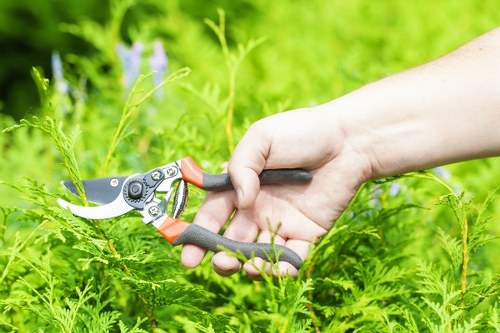
Customers often want to know what they are actually getting when they book tree thinning. While every job is different, a professional crown thinning service will usually include a combination of assessment, selective pruning, waste removal, and final tidying. The exact scope depends on the tree, its condition, and the access available on site.
In Osterley, it is common for jobs to involve careful planning around driveways, neighbouring properties, narrow side access, and garden features such as decking, sheds, fencing, and planted borders. A good local team will take steps to protect the site and complete the work with minimal disturbance. That is particularly useful for occupied homes, businesses open during the day, and managed communal spaces where neatness matters.
What is usually included?
- Assessment of the tree and discussion of your aims.
- Selective removal of crowded or poorly placed branches.
- Improved spacing through the crown while maintaining a natural outline.
- Clearing and removal of branches and debris from the work area.
- Advice on whether any follow-up tree care may be beneficial.
Some customers also ask whether the same visit can address more than one tree. That may be possible depending on the layout and the condition of the trees involved, although each specimen should be judged on its own merits. A mixed garden may benefit from thinning one tree, light pruning on another, and a different approach altogether on a third.
Residential and Commercial Crown Thinning in Osterley
For Homes, Estates, and Business Premises
Crown thinning is not just for private gardens. It can also be valuable for commercial properties, rental buildings, communal estates, schools, care settings, and managed grounds in and around Osterley. Each setting has different priorities, but the core goals are often the same: make the trees safer, keep them attractive, and ensure they fit the space properly.
For homeowners, the concern is often about light, privacy, and the way a large tree affects everyday use of the garden. For businesses or managed properties, the priorities may include presentation, access routes, visibility, and keeping external areas welcoming for visitors. A local arborist who understands both environments can adapt the work accordingly.
Commercial customers may also need work carried out with minimal disruption. That can mean planning the job around opening hours, limiting noise where possible, and keeping access routes clear. Where parking or turning space is limited, local experience is especially helpful because it reduces delays and helps the crew arrive prepared for the site.
Types of Customers Who Commonly Request Thinning
- Homeowners with mature trees close to the house.
- Landlords and managing agents looking after shared gardens.
- Businesses that want a tidy and professional exterior.
- Schools and community sites needing practical tree management.
- Property owners preparing for seasonal growth or windy weather.
Whatever the setting, the most important thing is that the tree is treated as a living asset, not just as something to be cut back. The right service keeps the tree useful, healthy, and suited to its location.
Preparing for Crown Thinning: A Simple Checklist
Good preparation helps the work go smoothly and can save time on the day. You do not need to do anything complicated, but a few practical steps can make access easier and help the team work safely around your property. This is especially useful in Osterley, where many homes have side paths, shared entrances, driveways, and limited on-street space.
Before the appointment, it is worth thinking about what you want to achieve. Do you want more light? Less wind catch? A better shape? More room over a patio or driveway? The clearer your aim, the easier it is for the arborist to recommend the right level of thinning. If there are specific concerns about branches close to windows, fences, sheds, or neighbouring boundaries, mention those as well.
Preparation checklist:
- Move vehicles if access will be needed near the tree.
- Clear away garden furniture, pots, toys, or fragile items close to the work area.
- Keep gates unlocked or make sure access arrangements are agreed in advance.
- Let the team know about hidden features such as cable runs, irrigation, or underground services if relevant.
- Point out any branches that concern you most.
- Arrange access to side passages, rear gardens, or communal spaces if needed.
If the tree sits near neighbours or shared boundaries, it is sensible to consider how the work may affect both sides. Professional pruning should be respectful and tidy, with branches handled carefully and debris removed once the job is complete.
Pricing Factors: What Affects the Cost of Thinning a Crown?
Why Quotes Can Vary
Customers often ask how crown thinning is priced. While it is not appropriate to promise a fixed figure without seeing the tree, there are several common factors that influence the quote. The main point is that different trees require different levels of skill, time, equipment, and cleanup.
In Osterley, access can be one of the biggest considerations. A tree in a large open garden may be straightforward to reach, while a tree in a tight rear garden with only narrow side access may take longer to work on. Parking limitations, the need to protect hard landscaping, and whether the site is residential or commercial can all affect the planning and labour involved.
Other pricing factors can include the tree’s size, species, density, height, condition, and how much thinning is needed. A tree that is heavily congested or has structural issues may require more careful work than a healthy tree with only moderate density. Good quotes are based on the actual site, not assumptions.
Common Factors That Influence a Quote
- Tree height, spread, and overall density.
- Species and the way that species responds to pruning.
- Access to the work area and space for equipment.
- Whether waste removal and full site clearance are needed.
- How complex the tree structure is and how selective the cuts must be.
- Any nearby obstacles, boundaries, or safety considerations.
If you are comparing options, ask what is included in the service so you can make a fair comparison. A thorough assessment and a careful pruning plan are usually better value than a rushed job that leaves the tree unbalanced or the site untidy.
Why Choose a Local Company for Crown Thinning in Osterley?
There are real advantages to using a local team for tree work. A company that regularly works in Osterley and the surrounding area is more likely to understand local property layouts, access patterns, and the types of trees commonly found in the area. That can make the whole process easier from the first visit through to the final tidy-up.
Local knowledge also helps with practical issues. If a property has limited parking, narrow side access, mature boundary planting, or shared drives, a local arborist can arrive prepared for those conditions. If the work needs to be arranged around neighbours, tenants, or business users, a nearby team is often better placed to respond flexibly and keep disruption down.
There is also reassurance in choosing a company that deals regularly with a variety of local settings, from family homes near Osterley Park to commercial premises and residential roads around the wider area. When your tree work is handled by people who understand the local environment, the result is usually smoother, neater, and more practical.
Nearby Areas Often Covered
Customers in and around Osterley may also need tree services in neighbouring locations such as Isleworth, Hounslow, Brentford, Southall, Hanwell, and nearby parts of West London. If your property sits close to these areas, a local service can often plan attendance efficiently while still giving attention to the specific conditions of your site.
Because every property is different, the best service is one that starts with listening. If you want a tree to feel lighter, look neater, or allow more sunlight into your space, the pruning method should reflect that goal rather than following a one-size-fits-all approach.
How to Decide Between Crown Thinning and Other Tree Work
Thinning, Reduction, and General Pruning
It is easy to assume all tree work does the same thing, but the method matters. Crown thinning is a good fit when the tree is healthy, mature, and basically the right size, but just too dense. If the tree is too tall, too wide, or encroaching too strongly into buildings or overhead spaces, a different type of pruning may be more appropriate. In some cases, a light structural prune or crown reduction may deliver a better result.
A sensible arborist will not recommend thinning just because it is a common term. Instead, they will look at the actual tree and explain what kind of work is suitable. For example, a broad-canopy ornamental tree may respond well to selective thinning, while a different species may need only minor correctional pruning. The aim is always to improve the tree without compromising its health or shape.
Ask yourself: do you want the tree smaller, or just less crowded? If the tree is already the right size but feels heavy, crown thinning may be the answer. If size is the main issue, another approach might be better. A proper assessment removes the guesswork and helps you choose the right service.
Helpful Questions to Raise During an Assessment
- Will thinning improve light without making the tree look sparse?
- Is the tree species suitable for this kind of pruning?
- How much canopy should be removed?
- Will the work help with wind exposure or branch rubbing?
- Are there nearby structures, fences, or neighbours to consider?
Asking these questions can help you feel confident about the work and understand the result you can expect.
Frequently Asked Questions About Crown Thinning in Osterley
[IMG_?]Is crown thinning bad for the tree?
No, not when it is carried out correctly. In fact, selective thinning is often beneficial because it improves airflow, reduces crowded growth, and helps maintain a healthier structure. Problems usually arise when too much is removed or when the work is done without regard for the species and condition of the tree.
How often does a tree need thinning?
That depends on the species, age, and growing conditions. Some trees may need attention every few years, while others need less frequent work. A local arborist can advise on a sensible maintenance interval after seeing the tree.
Will thinning make my tree look bare?
It should not. Proper crown thinning is selective and subtle. The tree remains full, but lighter and more open. If the goal is to keep the tree looking natural, that should be part of the pruning plan from the start.
Can crown thinning help with neighbours’ light or overhanging branches?
Yes, it can often improve light levels and reduce the spread of dense growth near boundaries. If overhanging is the main concern, the arborist may discuss whether thinning alone is enough or whether some additional selective pruning is sensible.
Do you carry out crown thinning for businesses as well as homes?
Yes. Crown thinning can be useful for commercial sites, communal gardens, schools, and other managed properties where appearance, safety, and usability are important.
Do I need permission before work starts?
That depends on whether the tree is subject to a preservation order or located in a conservation area. If either applies, this must be checked before work is undertaken. A responsible local company will raise this during the enquiry stage where relevant.
If you have a question about a specific tree in Osterley, the best next step is usually a site assessment. Trees are living structures, and the right decision often depends on what the canopy is doing right now, not just on how it looks from a distance.
What to Expect from a Professional Local Team
When you book crown thinning in Osterley, you should expect a service that is careful, respectful, and clear from the start. Good tree care is not only about cutting branches; it is about understanding the tree, the property, and the result you want. The team should be able to explain what they recommend, why they recommend it, and what the likely outcome will be.
Professionalism also shows in the details. That includes arriving prepared for access conditions, protecting surrounding surfaces where needed, working safely around fences and buildings, and leaving the site tidy once the job is complete. For many local customers, this practical reliability is just as important as the pruning itself.
Book your service now if you want a tree that lets in more light, feels better balanced, and fits your space more comfortably. Whether the tree is in a private garden, a shared space, or a commercial setting, a local crown thinning service can make a real difference to how the whole property feels.
Good Reasons to Enquire Today
- Your tree is shading the garden more than you want.
- Branches are too close to windows, fences, or neighbouring spaces.
- The canopy feels too heavy in windy weather.
- You want to improve the appearance of a mature tree without cutting it back hard.
- You need practical tree care from a team familiar with Osterley properties.
Contact us today to request a free quote and discuss the best approach for your tree. With the right advice and a careful thinning plan, you can keep the tree you value while making the space beneath it more enjoyable and easier to use.
Final Thought for Local Property Owners
If you have been putting off tree work because you do not want to spoil the look of a mature tree, crown thinning may be the solution you have been looking for. It is subtle, practical, and well suited to the kind of established properties found in Osterley. Done correctly, it can bring back light, improve shape, and help the tree sit more comfortably within its surroundings.
For a considerate, site-specific service that respects both your tree and your property, speak to a local team and arrange an assessment.